
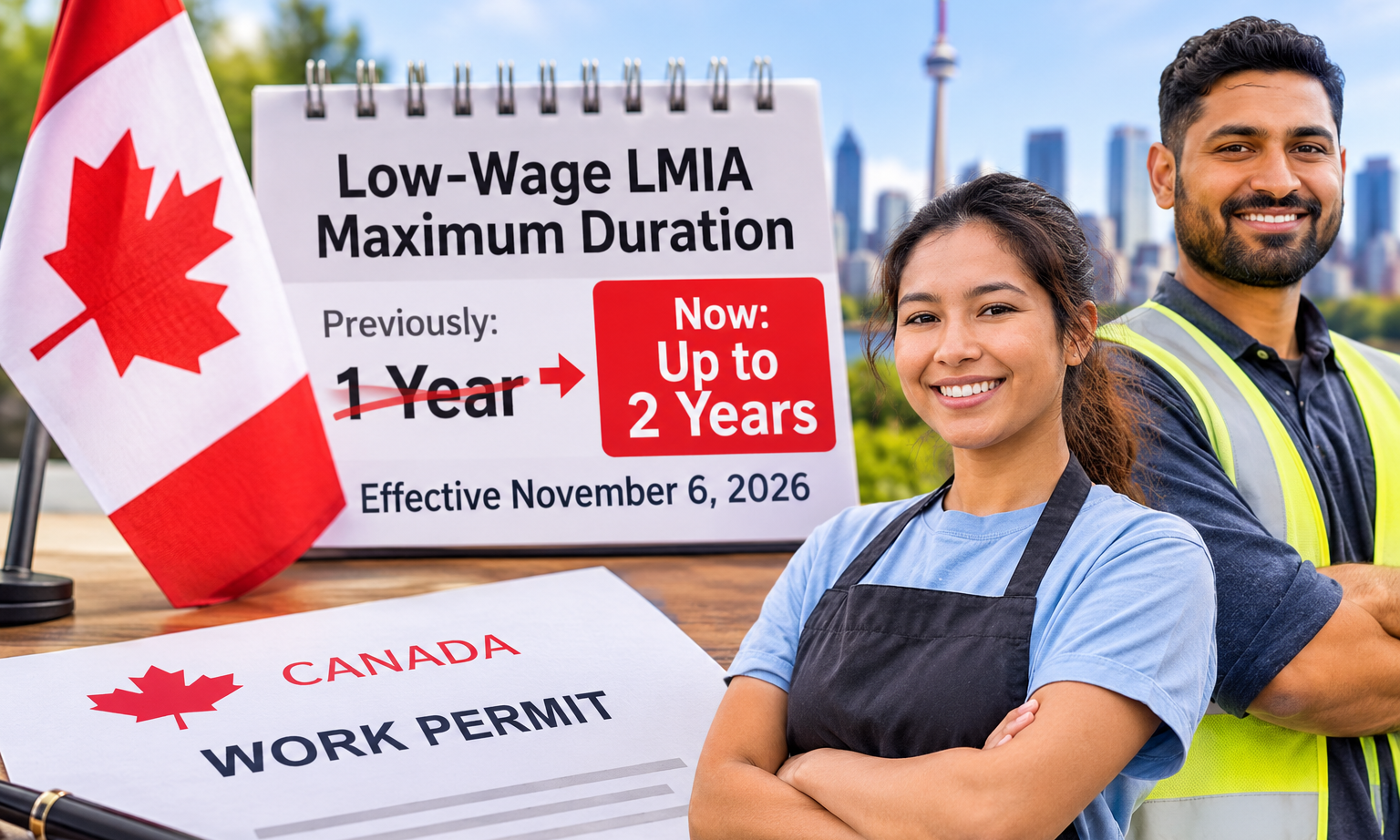
Effective November 6, 2026, Canada has increased the maximum duration of Labour Market Impact Assessments (LMIAs) under the Low-Wage Stream of the Temporary Foreign Worker Program (TFWP) from one year to up to two years.
The change is intended to give employers greater workforce stability, reduce the frequency of LMIA applications and provide eligible foreign workers with the possibility of longer periods of authorized employment.
For employers that rely on temporary foreign workers, this may reduce administrative costs and recruitment disruptions. For foreign workers, it may create an opportunity to obtain an employer-specific work permit for a longer period, depending on the LMIA and IRCC’s decision.
However, the change does not automatically extend existing work permits, eliminate LMIA requirements or guarantee a two-year work permit.
Here is what the new policy means in practice.
1. What has changed under the Temporary Foreign Worker Program?
On November 6, 2026, Employment and Social Development Canada (ESDC) announced changes to the Low-Wage Stream of the TFWP.
The most significant change is the increase in the maximum employment duration that can be supported by a low-wage LMIA.
| LMIA application | Previous maximum | New maximum |
|---|---|---|
| Low-Wage Stream | 1 year | Up to 2 years |
The new maximum applies to low-wage LMIA applications submitted on or after November 6, 2026.
This means employers can request an employment period of up to two years instead of being limited to the previous one-year maximum.
The change is intended to improve predictability for businesses that depend on temporary foreign workers, particularly in sectors experiencing ongoing recruitment and retention challenges.
Importantly, two years is the maximum permitted duration, not an automatic approval period. ESDC will continue to assess each LMIA application based on the employer’s circumstances and applicable program requirements.
2. Does this mean foreign workers can now receive two-year work permits?
Potentially, yes.
Under the TFWP, most foreign workers who require an LMIA must first have an employer obtain a positive or neutral LMIA from ESDC.
The LMIA includes an assessed employment duration, which establishes the period that may be supported when the worker applies for an employer-specific work permit.
With the new policy, an eligible low-wage position may now support employment for up to two years.
If ESDC approves an LMIA with a two-year employment duration, the foreign worker may be able to apply for a work permit covering a longer employment period.
However, the distinction between the LMIA and the work permit is important:
- ESDC assesses the employer’s LMIA application and the employment duration it can support.
- IRCC assesses the foreign worker’s work permit application and determines the actual validity period of the permit.
- The worker must independently satisfy the applicable immigration, admissibility and work permit requirements.
Therefore, an LMIA approved for two years does not guarantee that IRCC will issue a work permit valid for the full two years.
3. Which foreign workers may benefit from the new rule?
The change applies to foreign workers hired through the Low-Wage Stream of the TFWP.
Whether a position falls under the Low-Wage Stream depends on the applicable provincial or territorial wage threshold.
Generally, positions paying below the applicable threshold are classified as low-wage positions, while positions paying at or above the threshold fall under the High-Wage Stream.
The new two-year maximum is particularly relevant to employers hiring workers in occupations where wages fall below the applicable threshold.
Examples may include positions in:
- Food services and hospitality
- Retail and customer service
- Food processing and manufacturing
- Certain transportation and logistics occupations
- Cleaning and maintenance
- Other eligible low-wage occupations
These examples do not mean that every position in these industries qualifies for an LMIA. Employers must still meet the requirements of the TFWP, including applicable restrictions on processing low-wage applications.
4. Does the new rule apply to existing low-wage LMIA applications and work permits?
The effective date is important.
The new maximum duration applies to LMIA applications submitted on or after November 6, 2026.
Consequently:
- LMIA applications submitted before November 6, 2026, remain subject to the previous maximum duration.
- Applications submitted on or after November 6 may request an employment duration of up to two years.
- Existing work permits are not automatically extended because of this policy change.
- Workers who want to continue working beyond their current authorization must follow the applicable work permit extension process.
For example, a foreign worker whose employer obtained a one-year low-wage LMIA before November 6, 2026, cannot automatically convert that LMIA into a two-year approval simply because the new policy is now in effect.
If the employer wants to continue employing the worker beyond the period supported by the existing LMIA, a new LMIA may be required.
Workers should therefore review their current work permit expiry dates and discuss future employment arrangements with their employers well before their authorization expires.
5. Do employers still need to obtain an LMIA?
Yes.
The increase in the maximum duration does not eliminate the LMIA requirement.
Employers hiring foreign workers through the Low-Wage Stream must continue to demonstrate that they meet the applicable TFWP requirements.
These generally include:
Genuine business and job offer
The employer must operate a legitimate business and demonstrate a genuine need for the position. The employment offer must reflect actual job duties, wages and working conditions.
Recruitment efforts
Employers must make the required efforts to recruit Canadian citizens and permanent residents before hiring a foreign worker.
Prevailing wage
The offered wage must meet the applicable prevailing-wage requirements for the occupation and location.
Full-time employment
The position must generally provide at least 30 hours of work per week.
Workforce cap
Employers must comply with the applicable limit on the proportion of low-wage temporary foreign workers at the work location. The standard cap is generally 10%, although certain sectors and occupations are subject to a 20% limit or other exceptions.
Employment conditions and compliance
Employers must comply with applicable employment standards, workplace safety requirements and TFWP conditions.
The standard LMIA processing fee is $1,000 per position and must be paid by the employer. This fee cannot be recovered from the foreign worker.
The longer employment duration does not reduce the employer’s responsibility to demonstrate a genuine labour need or comply with the program.
6. What happens if a low-wage job is located in a high-unemployment metropolitan area?
The two-year LMIA change does not remove the separate restrictions on processing low-wage LMIA applications in certain metropolitan areas.
Under the existing policy, ESDC generally refuses to process low-wage LMIA applications for positions located in Census Metropolitan Areas (CMAs) with unemployment rates of 6% or higher, subject to designated exceptions.
This restriction remains relevant even after the increase in the maximum LMIA duration.
However, on November 6, 2026, the government also added early childhood educators to the list of occupations exempt from this geographic processing restriction.
This means qualifying early childhood educator positions may be considered for low-wage LMIA processing in affected metropolitan areas.
Other employers should check the applicable unemployment rate, location and occupational exemptions before submitting an application.
A longer potential LMIA duration does not mean every low-wage employer can now hire foreign workers in every Canadian city.
7. What does the change mean for foreign workers already in Canada?
Foreign workers currently employed under the Low-Wage Stream should not assume that the new policy automatically changes their immigration status or work authorization.
The practical implications depend on the worker’s current situation.
Workers with valid work permits
If your work permit is still valid, you may continue working under its existing conditions until its expiry date.
The new policy does not automatically change the expiry date printed on your permit.
Workers approaching work permit expiry
If your employer wants to continue employing you, discuss the possibility of obtaining a new LMIA under the revised rules.
A new low-wage LMIA application submitted on or after November 6, 2026, may support an employment period of up to two years.
The employer must still satisfy all applicable requirements, and you must submit the appropriate work permit application.
Workers whose work permits have already expired
The new policy does not restore expired immigration status or automatically authorize you to continue working.
If your status has expired, you should determine whether you qualify for restoration or another appropriate immigration option. Do not continue working without authorization.
8. Can a two-year LMIA help foreign workers obtain permanent residence?
A longer LMIA may provide greater employment stability, but it does not automatically create a pathway to permanent residence.
Foreign workers may explore separate economic immigration programs, including:
- Express Entry: Depending on their qualifications, work experience, language ability and eligibility, workers may qualify under the Canadian Experience Class or another Express Entry program.
- Provincial Nominee Programs (PNPs): Some provinces have streams for workers with qualifying employment offers or Canadian work experience.
- Atlantic Immigration Program (AIP): Eligible workers with qualifying job offers from designated employers in Atlantic Canada may be able to pursue permanent residence.
- Other regional or occupation-specific programs: Eligibility depends on the applicable provincial, territorial or federal requirements.
However, a low-wage job offer or a two-year LMIA does not automatically qualify a worker for any of these programs.
Applicants should assess their occupation, work experience, education, language results and the specific requirements of the immigration pathway they intend to pursue.
They should also avoid assuming that a longer temporary work authorization will necessarily lead to permanent residence.
9. Are more changes coming to the Low-Wage Stream in 2027?
Yes. The federal government has also proposed additional changes to the TFWP, with a proposed implementation date of March 1, 2027.
These measures are contingent on provinces and territories choosing to participate.
The proposed framework includes:
- Continuing restrictions on low-wage LMIA processing in CMAs with unemployment rates of 6% or higher, except for designated priority sectors.
- Providing targeted access to certain occupations in large metropolitan areas with unemployment rates below 6%.
- Extending targeted access to rural areas of large CMAs and smaller CMAs.
- Maintaining broader access to low-wage positions in rural communities.
- Allowing participating provinces and territories to request an increase in the low-wage temporary foreign worker cap from 10% to 15% for eligible employers in designated communities.
These measures are separate from the two-year LMIA duration change, which took effect on November 6, 2026.
Employers and foreign workers should distinguish between changes that are already in effect and measures that remain proposed.
10. What should employers and foreign workers do now?
For Canadian employers:
- Review current staffing needs and determine whether the Low-Wage Stream is appropriate for the position.
- Check the applicable provincial or territorial wage threshold.
- Confirm whether the work location is subject to the 6% unemployment restriction or another processing limitation.
- Review recruitment, prevailing-wage and workforce-cap requirements.
- Consider whether requesting an employment period of up to two years would provide greater staffing stability.
- Ensure the LMIA application is submitted on or after November 6, 2026, if seeking the benefit of the new maximum duration.
For foreign workers:
- Review your current work permit conditions and expiry date.
- Ask your employer whether a new LMIA application will be required to continue your employment.
- Confirm whether your occupation and work location are eligible under the Low-Wage Stream.
- Do not assume that an existing LMIA or work permit automatically becomes valid for two years.
- If you are considering permanent residence, assess your eligibility under the relevant federal or provincial immigration programs.
- Make sure you maintain valid immigration status and obtain the required authorization before continuing to work.
Conclusion
Canada’s decision to increase the maximum duration of low-wage LMIAs from one year to up to two years is an important adjustment to the Temporary Foreign Worker Program.
Effective November 6, 2026, the change may give eligible employers more flexibility in workforce planning and allow foreign workers to pursue longer periods of employment authorization.
Nevertheless, the change does not eliminate LMIA requirements, override restrictions in high-unemployment metropolitan areas or automatically extend existing work permits.
The most important point is that a two-year LMIA is an opportunity, not a guarantee of a two-year work permit or permanent residence.
Employers should review the revised LMIA requirements before submitting applications, while foreign workers should carefully assess their current work authorization and long-term immigration options.

