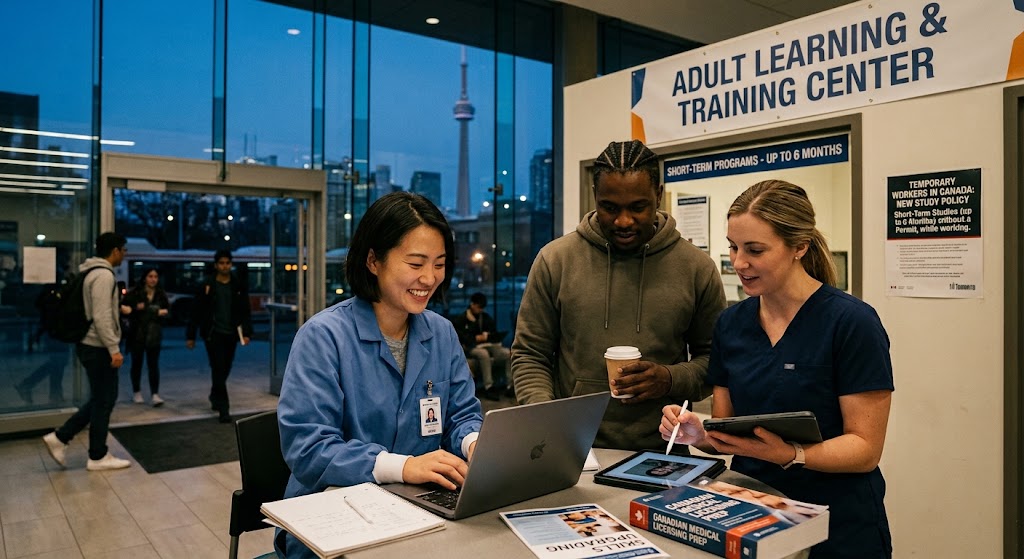
Canada has introduced a new temporary measure that gives eligible foreign workers in Canada more flexibility to pursue short-term education and training.
As of September 4, 2026, eligible work permit holders can study in Canada for up to 6 months without applying for a separate study permit. The measure is designed to help temporary workers gain additional skills, pursue short-term licensing or training opportunities, and continue working while they study.
The measure is particularly relevant to workers who want to upgrade their qualifications without leaving their jobs or going through a separate study permit application.
However, there are important conditions.
Who Can Use This New Measure?
Under IRCC’s temporary public policy, a worker may be eligible if:
- They hold a valid work permit
- Their program of study is 6 months or less
The authorization lasts for up to 6 months or until the work permit expires, whichever comes first.
For example, if a worker has a valid work permit for another eight months, they may study for up to six months without a study permit.
If the work permit expires in four months, however, the worker’s authorization to study under this policy only lasts until the work permit expires.
Why Did Canada Introduce This Change?
IRCC describes the measure as a way to help temporary workers already in Canada develop skills that are needed in the Canadian labour market.
The government specifically highlighted workers such as:
- Tradespeople
- Nurses
- Laboratory technicians
The measure can also help workers pursue short-term licensing, education or training opportunities while continuing to work.
This is therefore more than simply a convenience for students.
It is intended to help Canada make better use of workers who are already legally working in the country.
What Can Workers Study?
The public policy allows eligible workers to study in a program that is no longer than 6 months.
This could potentially include short-term:
- Professional training
- Skills upgrading
- Licensing-related education
- Career development programs
- Other short-term educational programs
The exact admission requirements still depend on the educational institution and the program.
The temporary measure does not mean that every educational program becomes available without a study permit.
The program itself must meet the six-month limit.
What If the Worker Wants to Study for More Than 6 Months?
A study permit is still required for studies that go beyond the six-month limit.
For example:
4-month program → potentially no study permit under the policy
6-month program → potentially no study permit
8-month program → study permit required
2-year college program → study permit required
IRCC’s general rules continue to require a study permit for longer-term studies.
What If the Worker Wants to Study Full-Time?
This is an important distinction.
IRCC’s announcement states that full-time studies will still require a study permit.
Therefore, the headline “temporary workers can study for six months without a study permit” should not be interpreted as:
Every work permit holder can simply enroll in any six-month full-time program without a study permit.
The public policy has to be considered together with the worker’s circumstances and the applicable study rules.
IRCC also states that if a worker studies full-time under the temporary policy, the work experience gained during those studies will not count toward Canadian Experience Class eligibility or Canadian work experience points under Express Entry’s CRS.
This could be particularly important for workers who are accumulating Canadian work experience for permanent residence.
Does the Worker Need to Stop Working?
No.
The measure is specifically designed to allow eligible workers to study while continuing to work.
However, the worker still has to comply with the conditions of the work permit.
IRCC notes that workers remain responsible for meeting the conditions of their employment contract and should reach an agreement with their employer if studying requires changes to their work schedule, such as working fewer hours.
In other words:
The study authorization does not automatically change the worker’s employment conditions.
What About Workers in Quebec?
There is an important additional change for Quebec.
As of September 4, 2026, eligible workers in Quebec can also study without a study permit under this temporary public policy.
IRCC states that eligible workers in Quebec do not need a Quebec Acceptance Certificate (CAQ) for these studies under the temporary measure.
The IRCC policy and Quebec’s temporary CAQ exemption came into effect on the same date.
How Does the Worker Prove Eligibility?
The educational institution may ask the worker to demonstrate that they are eligible to study without a study permit.
IRCC states that, if requested, the worker should provide their valid work permit.
This makes it important for workers to keep their immigration documents available when registering for a program.
What About Co-op Work Placements?
There is a separate issue if the short-term program includes a co-op placement.
IRCC states that a worker may need a new employer-specific work permit before starting a co-op placement if the co-op employer or occupation is different from the worker’s current employer or occupation.
Open work permit holders do not need to apply for a new work permit in that situation.
Therefore, workers should not assume that authorization to study automatically authorizes every type of practical work placement connected to the program.
Does This Give Temporary Workers a New Pathway to Permanent Residence?
No.
This is one of the most important points.
IRCC explicitly states that the measure is not a new pathway for workers to come to Canada.
It is simply a temporary measure giving certain workers already in Canada more flexibility to study.
However, additional education or training could potentially help a worker’s career or licensing prospects.
Whether it improves the person’s permanent residence options depends on the particular immigration program and the nature of the education or work experience.
Will Studying Help With Express Entry?
Not necessarily.
Workers should be particularly careful about assuming that studying while working will automatically generate additional Canadian work experience for Express Entry.
IRCC specifically states that when a worker is studying full-time under this temporary public policy, work experience gained during the studies will not count toward:
- Canadian Experience Class eligibility
- Canadian work experience points under the CRS
Therefore, someone planning to use Canadian work experience for PR should examine the Express Entry rules before changing their work and study arrangements.
How Long Will This Temporary Measure Last?
The measure is currently scheduled to remain in effect until December 31, 2027.
Because this is a temporary public policy, workers should not assume that the measure will become permanent.
IRCC can change, extend or end temporary policies.
Example: How the New Rule Could Help
Consider a foreign worker in Canada with a valid work permit.
The worker wants to complete a four-month occupational training program that could improve their qualifications for a Canadian job.
Under the new measure, the worker may be able to:
Continue working
Complete the four-month program
Avoid applying for a separate study permit
provided the worker and program meet the requirements of the temporary public policy.
This removes an additional immigration application step for eligible workers.
What Workers Should Check Before Enrolling
Before registering for a program, check:
1. Is the work permit still valid?
The work permit must be valid.
2. Is the program 6 months or less?
The program cannot exceed six months under this policy.
3. Is the study full-time?
Full-time studies can have additional implications and may require a study permit.
4. Will the program affect the worker’s employment?
The worker should make sure the study schedule does not conflict with employment obligations.
5. Is the worker relying on Canadian work experience for PR?
If so, check whether the planned studies could affect how that work experience is counted.
6. Does the program include a co-op or work placement?
Additional work authorization may be required in some circumstances.
The Bottom Line
Canada’s new temporary measure gives eligible work permit holders an important new option:
Study for up to 6 months without a separate study permit, while continuing to work.
But it is not an unrestricted right to study.
The key conditions are:
Valid work permit
Program of 6 months or less
Compliance with applicable study and work conditions
And there is an important distinction between short-term study and longer or full-time programs.
For temporary workers already in Canada, the measure could make it easier to pursue short-term training, licensing and skills development without going through a separate study permit application.
The measure is currently scheduled to remain in effect until December 31, 2027.