For many temporary workers in Canada, a work permit is more than permission to work. It may also be the foundation for a future permanent residence application through Express Entry, a Provincial Nominee Program (PNP), the Atlantic Immigration Program, a community immigration pathway or another economic immigration program.
But having Canadian work experience does not automatically lead to permanent residence.
If a work permit is approaching its expiry date, the worker should deal with two separate questions:
- How can I maintain my legal status and, where permitted, continue working?
- What permanent residence pathway can I realistically qualify for?
These questions should be addressed before the work permit expires, not after.
1. Do Not Wait Until the Last Few Weeks
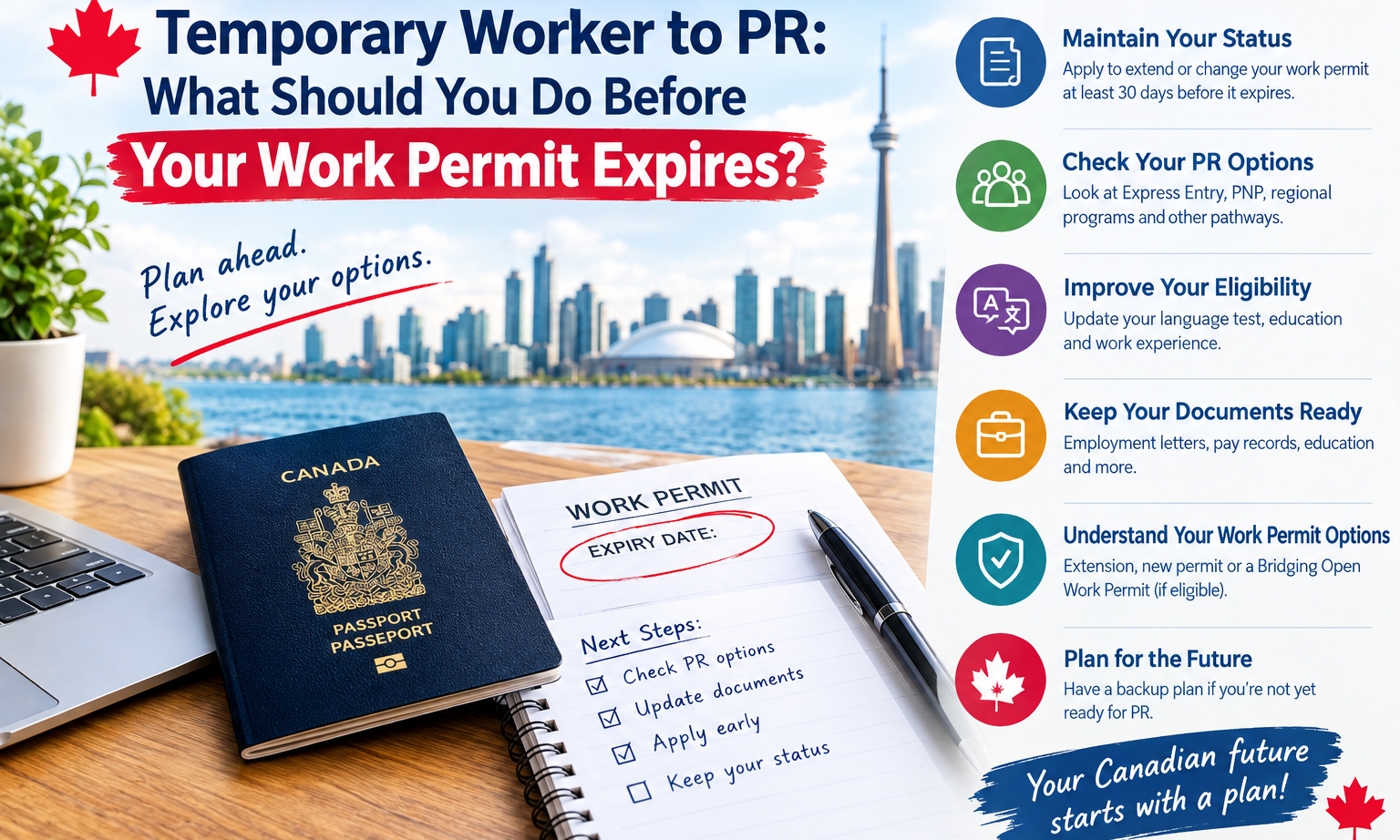
IRCC recommends applying to extend or change the conditions of a work permit at least 30 days before it expires. More importantly, IRCC must receive the application before the current work permit expires for maintained status to apply.
Waiting until the final days can create unnecessary problems, particularly if documents such as an LMIA, provincial nomination, employer compliance submission or other supporting evidence are required.
A worker should therefore check the expiry date and start planning well in advance.
A useful timeline
6–12 months before expiry
- Review permanent residence options.
- Check Canadian work experience.
- Check language-test validity.
- Review education and credential documents.
- Identify possible PNP or regional pathways.
- Determine whether an employer is willing and able to support a further work permit.
3–6 months before expiry
- Create or update an Express Entry profile if eligible.
- Review provincial programs and their current requirements.
- Determine whether additional Canadian work experience could improve eligibility.
- Arrange a new language test if the current result will expire.
- Start collecting employment documentation.
At least 30 days before expiry
- Submit any necessary work-permit extension application.
- Make sure the application is actually received by IRCC before the current permit expires.
- Keep proof of submission and payment.
The appropriate timing can be earlier depending on the worker’s pathway and circumstances.
2. Check Whether the Worker Already Qualifies for Permanent Residence
The first question should not be:
“How do I extend my work permit?”
It should be:
“Do I already qualify for permanent residence, or am I close to qualifying?”
For some workers, another year of Canadian employment may make a significant difference. For others, waiting may not solve the underlying problem.
Express Entry: Canadian Experience Class
The Canadian Experience Class (CEC) is one of the main pathways for temporary workers who have gained skilled Canadian work experience.
Among other requirements, the worker must generally have:
- at least 1 year or 1,560 hours of qualifying Canadian skilled work experience in the 3 years before applying;
- experience in NOC TEER 0, 1, 2 or 3;
- authorized work in Canada;
- paid work experience;
- work that meets the NOC lead statement and most of the main duties; and
- the required language level.
For CEC, the language requirement is generally:
- CLB 7 for TEER 0 or 1 occupations; and
- CLB 5 for TEER 2 or 3 occupations.
There is no education requirement for CEC itself.
However, qualifying for CEC does not necessarily mean receiving an Invitation to Apply (ITA). The applicant must still have a competitive CRS score in the relevant Express Entry pool.
This is why workers should assess their situation before their work permit gets close to expiry.
3. Calculate the Canadian Work Experience Correctly
A common mistake is assuming that simply having worked in Canada for one year automatically creates CEC eligibility.
The work must meet IRCC’s requirements.
For example, the worker should verify:
- the correct NOC;
- TEER classification;
- dates of employment;
- number of hours worked;
- whether the work was authorized;
- whether the position was paid;
- whether the actual duties match the NOC;
- whether there were periods of unpaid leave;
- whether any of the experience was gained while studying full-time; and
- whether self-employment is being counted incorrectly.
IRCC states that self-employment and work experience gained while the applicant was a full-time student generally do not count toward the CEC minimum requirement.
The employment record should therefore be reviewed before the worker assumes that the required 1,560 hours have been reached.
4. Take the Language Test Early
Language ability can be one of the most important factors in an economic immigration application.
A temporary worker should not wait until the work permit is about to expire before checking the language requirement.
A valid language test can help determine:
- whether the worker qualifies for a particular program;
- whether the worker can enter the Express Entry pool;
- the worker’s CRS score;
- whether additional language testing could improve the score; and
- whether a French-language pathway or category may be available.
If the language result is close to expiry, taking another test early can prevent the worker from being caught without valid results when a PR application or Express Entry profile needs to be updated.
5. Look at Provincial Nominee Programs
Express Entry is not the only option.
A worker should also check the province or territory where they live and work.
Provincial programs can have their own requirements relating to:
- occupation;
- employer;
- wage;
- work experience;
- education;
- language;
- job offer;
- location;
- employer eligibility; and
- length of employment.
These requirements can change quickly because provinces manage their immigration programs according to their allocations and labour-market priorities.
A worker should therefore use the current requirements, rather than relying on information from an earlier year.
A provincial nomination can also have major implications for Express Entry applicants, but workers should understand exactly which provincial stream they qualify for before relying on a nomination as their immigration plan.
6. Consider Regional and Community Immigration Options
Workers outside Canada’s largest cities should pay particular attention to regional pathways.
Canada’s current immigration strategy places significant emphasis on workers who are already established in smaller communities and who work in sectors experiencing labour shortages.
The government’s one-time In-Canada Workers Initiative is accelerating permanent residence for up to 33,000 temporary workers in 2026 and 2027, with a particular focus on smaller communities.
The initiative is not a general application program for every temporary worker.
IRCC says it is focusing on workers who have been living in smaller communities for at least two years and who have applied for permanent residence through programs such as:
- the Provincial Nominee Program;
- Atlantic Immigration Program;
- Rural Community Immigration Pilot;
- Francophone Community Immigration Pilot;
- caregiver pilots; and
- Agri-Food Pilot.
This distinction is important.
Being a temporary worker in a rural community does not, by itself, create eligibility for the 33,000-worker initiative.
The worker must still qualify through an eligible permanent residence program and meet the applicable requirements.
7. Do Not Assume That a PR Application Will Automatically Protect the Work Permit
This is one of the most important points.
A permanent residence strategy and a temporary work authorization strategy are related, but they are not automatically the same thing.
For example, creating an Express Entry profile is not the same as submitting an application for permanent residence.
IRCC specifically states that simply submitting a profile to the Express Entry pool does not make a person eligible for a Bridging Open Work Permit (BOWP).
A worker normally needs to reach a later stage of the PR process before becoming eligible for a BOWP.
8. Understand the Bridging Open Work Permit
A Bridging Open Work Permit can be extremely important for a worker whose PR application has been submitted but whose current work permit is approaching expiry.
The BOWP is designed to bridge the period between the expiry of the existing work permit and a final decision on the permanent residence application.
Eligibility depends on the specific permanent residence program.
For Express Entry applicants, IRCC generally requires the applicant to:
- be in Canada and intend to live outside Quebec;
- have valid temporary resident status, maintained status or otherwise meet the applicable status requirement;
- be the principal applicant;
- have submitted a complete PR application;
- have passed the completeness check; and
- have received an acknowledgement of receipt (AOR).
Therefore:
Express Entry profile → ITA → PR application → AOR → possible BOWP
These are different stages.
A worker should not wait until the final month of the work permit to discover that they are still only at the Express Entry profile stage and therefore cannot yet qualify for a BOWP.
9. If PR Is Not Ready, Protect the Work Authorization
What happens if the worker is not yet ready to submit a PR application?
The answer depends on the person’s specific work permit and circumstances.
If the worker submits an eligible work-permit extension application before the current permit expires, they can generally remain in Canada under maintained status while IRCC processes the application.
For an employer-specific work permit, maintained status generally allows the worker to continue working under the same conditions as the existing permit.
That normally means the same:
- employer;
- job; and
- work location.
An open work permit holder generally has greater flexibility to change employers, subject to the conditions of the permit.
This is why a worker should determine the available work-permit option before the current permit expires.
10. Be Careful When Changing Employers
Changing employers shortly before a work permit expires requires particular attention.
For an employer-specific work permit, submitting an application to change employers does not automatically mean the worker can immediately start the new job.
IRCC states that a worker who applies to change employer or job and whose current permit expires while the application is being processed generally must continue working for the original employer until the new work authorization is approved, unless IRCC provides separate authorization to work while processing.
This can be particularly important for workers who are counting on the new job to qualify for a provincial nomination or another PR pathway.
The worker should confirm the work authorization before starting the new employment.
11. Gather Employment Documents Before Leaving the Job
A temporary worker planning a PR application should maintain a complete employment record.
Useful documents can include:
- employment contracts;
- job offers;
- work permits;
- pay statements;
- T4s;
- Notices of Assessment;
- records of employment;
- employer reference letters;
- job descriptions;
- schedules or timesheets where appropriate; and
- evidence of employment dates and hours.
The employer reference letter is particularly important because IRCC may need to assess whether the actual employment corresponds to the claimed NOC and whether the required duties and hours were completed.
It is generally much easier to obtain accurate employment documentation while the employment relationship is still active.
12. Check Whether the NOC Still Matches the Job
A worker should not select a NOC simply because its job title sounds similar to their position.
IRCC assesses the actual work performed.
For CEC, the experience must correspond to the NOC’s lead statement and most of its listed main duties.
A change in duties, promotion or job title can therefore affect the immigration analysis.
Before submitting a PR application, the worker should compare the actual duties with the current NOC description and make sure the evidence supports the claimed occupation.
13. Check the Work Permit’s Expiry Date Against the PR Timeline
Consider a worker whose permit expires in four months.
The worker has:
- enough Canadian experience for CEC;
- a valid language test;
- an Express Entry profile; but
- a CRS score that has not yet resulted in an ITA.
There is no guarantee that an ITA will arrive before the work permit expires.
In this situation, simply waiting for an invitation can create unnecessary risk.
IRCC itself advises people who are not yet eligible for a BOWP not to let their work permit expire while waiting for an invitation. Instead, they should look at whether they can extend their work permit.
The appropriate extension route depends on the person’s circumstances and may require employer involvement.
14. Do Not Assume That Canada’s 33,000-Worker Initiative Means Everyone Can Stay
The announcement of accelerated PR for up to 33,000 workers is significant, but it should not be interpreted as a general temporary-worker-to-PR program.
The initiative is targeted.
IRCC’s current information indicates that the workers being accelerated are already in the permanent residence application inventory through specified economic programs and meet the initiative’s focus on smaller communities and established residence there.
Therefore, a temporary worker should not allow a work permit to expire on the assumption that the 33,000-worker initiative will provide another opportunity to remain in Canada.
15. Consider French-Language Opportunities
French-language ability can be particularly valuable in Canada’s current economic immigration system.
Workers who have French-language skills should check whether their language results could support:
- Express Entry category-based selection;
- French-language immigration pathways;
- Francophone Community Immigration Pilot opportunities;
- provincial programs; or
- other regional programs.
French-language immigration remains a stated federal priority, particularly outside Quebec.
However, workers should assess their eligibility under the current program requirements rather than assuming that speaking French automatically creates a PR pathway.
16. What If the Worker Is Still Not Eligible for PR?
Not every temporary worker will be ready for permanent residence before their work permit expires.
Possible options can include, depending on the circumstances:
- extending the existing work permit;
- obtaining a new employer-specific work permit;
- applying for another eligible work permit;
- obtaining a provincial nomination and then applying for the appropriate work authorization;
- qualifying for another economic immigration program;
- applying for a study permit where appropriate; or
- changing status to visitor if the person has no authorization to continue working.
The last option is important because visitor status does not authorize the person to keep working.
Similarly, applying for a study permit does not automatically extend work authorization beyond the expiry of the work permit. IRCC states that a worker who applies for a study permit can continue working only until the existing work permit expires, unless another authorization applies.
17. A Special 2026 Development: Some Workers Can Study Without a Study Permit
There is also a temporary public policy that may be relevant to some workers.
Effective September 4, 2026, eligible temporary workers with valid work permits can study in programs of 6 months or less without obtaining a study permit, subject to the conditions of the public policy.
This does not mean that a work permit holder can use the policy to remain in Canada indefinitely or to study after the work permit expires.
The authorization under the temporary policy is tied to the worker’s valid work authorization and the policy’s conditions.
Workers considering education as part of a longer-term immigration strategy should therefore distinguish between:
- studying under the temporary worker public policy;
- obtaining a study permit; and
- gaining Canadian work experience that qualifies for permanent residence.
These are different immigration mechanisms.
18. Build a Backup Plan
A strong immigration strategy should not depend on a single event.
For example:
Plan A: Express Entry
Plan B: Provincial nomination
Plan C: Regional/community immigration pathway
Plan D: Eligible work-permit extension
The appropriate options will vary by occupation, province, employer, language ability, education, family circumstances and immigration history.
The important point is to identify alternatives before the current work authorization becomes urgent.
19. What Should a Temporary Worker Do 6 Months Before Expiry?
A practical checklist is:
Immigration status
- Check the exact work-permit expiry date.
- Confirm the type of work permit.
- Review all conditions on the permit.
- Check passport expiry.
- Check whether provincial documents will also expire.
Permanent residence
- Check CEC eligibility.
- Calculate qualifying Canadian work experience.
- Identify the correct NOC.
- Check language-test validity.
- Calculate CRS score.
- Review PNP options.
- Review regional programs.
- Check whether French-language pathways may apply.
Documentation
- Obtain an updated employer reference letter if appropriate.
- Keep pay statements and tax documents.
- Verify employment dates and hours.
- Gather education and credential documents.
- Check police certificate and medical requirements where relevant.
Work-permit strategy
- Determine whether an extension is possible.
- Determine whether the employer must obtain an LMIA or complete another employer process.
- Determine whether a BOWP could eventually be available.
- Do not assume that an Express Entry profile provides work authorization.
Contingency planning
- Decide what happens if no ITA arrives before expiry.
- Determine whether another work permit may be available.
- Consider whether a provincial or regional pathway provides another route.
- Avoid unauthorized work after the current authorization ends.
The Bottom Line
A temporary worker should not wait until the work permit is about to expire before thinking about permanent residence.
The safest approach is to work backward from the expiry date:
Work permit expiry → PR eligibility → Express Entry/PNP or other pathway → PR application → possible bridging work permit → permanent residence
But the steps do not happen automatically.
A temporary worker may have enough Canadian experience for permanent residence but still need an ITA. An Express Entry profile does not itself create BOWP eligibility. A pending PR strategy does not automatically extend a work permit. And a work-permit extension may require employer action.
Canada is currently placing significant emphasis on transitioning people who are already in Canada into permanent residence. The federal government has announced a one-time initiative to accelerate the transition of up to 33,000 skilled temporary workers in 2026 and 2027, particularly workers established in smaller communities and in specified economic immigration programs.
That creates opportunities for some temporary workers—but it does not eliminate the need to plan carefully.
The key rule is simple: start the PR and work-permit strategy before the expiry date, not after it.