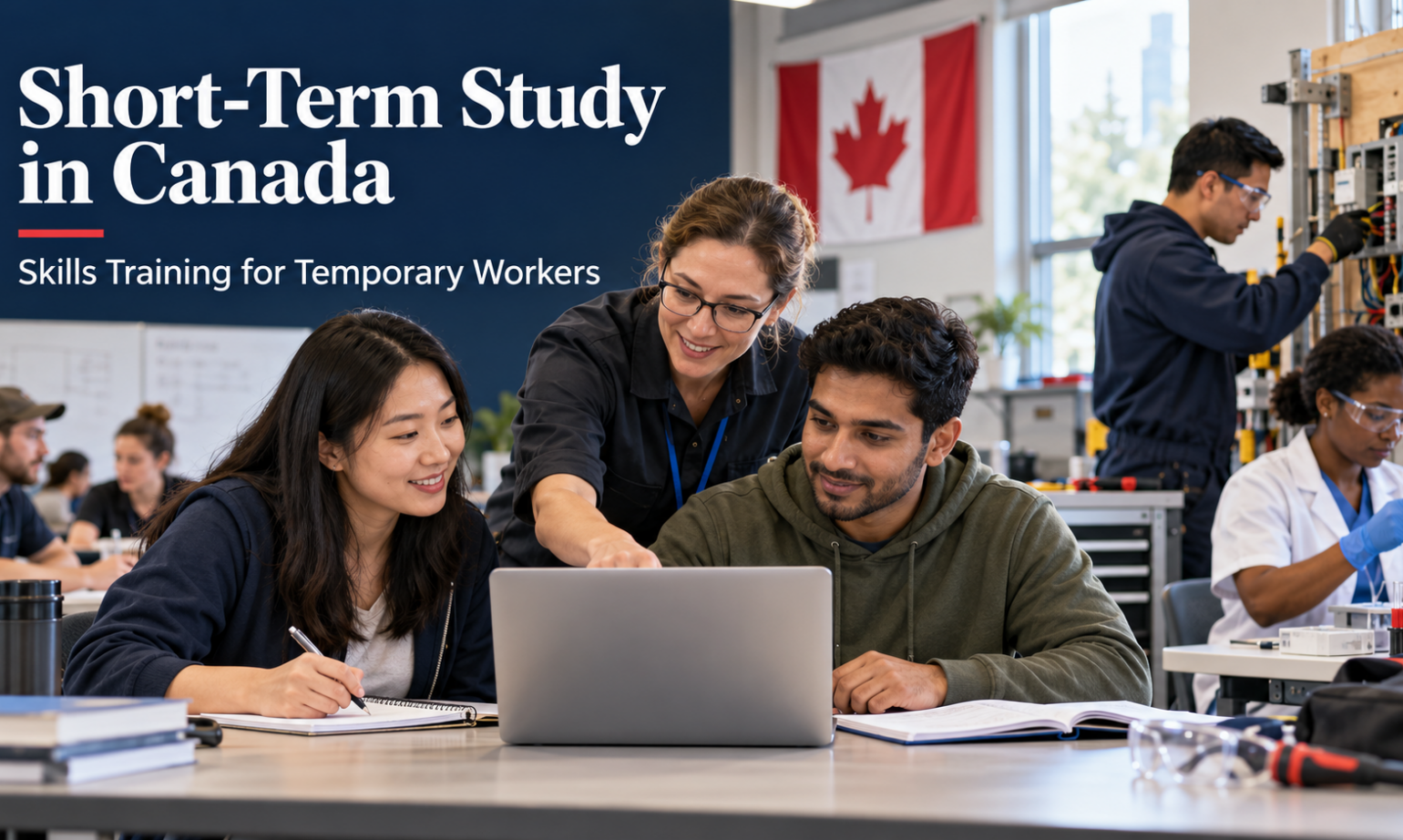
Canada’s new study rule for temporary foreign workers could create an important opportunity for people who want to upgrade their skills without going through the normal study permit process.
Since September 4, 2026, eligible work permit holders in Canada have been allowed to study in a course or program lasting six months or less without obtaining a study permit.
The temporary measure is scheduled to remain in effect until December 31, 2027.
But simply taking a six-month course does not necessarily improve your career or immigration prospects.
The more important question is:
Which short-term training programs could actually be useful?
For some workers, the best choice may be language training. For others, it could be a trade certification course, healthcare-related training, professional licensing preparation, technical training or a credential that helps them move into a higher-skilled position.
Understanding what the new rule allows—and what it does not—is therefore essential.
What Is Canada’s New 6-Month Study Rule?
Under the temporary public policy, a foreign national may be eligible to study without a study permit if:
- they hold a valid work permit; and
- the course or program lasts six months or less.
The authorization lasts for up to six months or until the work permit expires, whichever comes first.
This second condition is particularly important.
For example, if your work permit has only four months remaining, the new policy does not automatically give you six months of study authorization. Your ability to study under the exemption ends when your work permit expires.
IRCC introduced the measure specifically to give workers already in Canada more flexibility to pursue short-term education, licensing and training while continuing to participate in Canada’s labour market.
Workers in Quebec can also qualify under the temporary measure. Eligible workers studying in Quebec under this policy do not require a Quebec Acceptance Certificate (CAQ) for the qualifying short-term studies.
Why Could This Be Valuable?
A six-month program is relatively short.
But six months can still be enough to obtain a practical credential, improve language ability, prepare for a licensing examination or acquire a technical skill that changes the type of work you can perform.
IRCC has specifically identified tradespeople, nurses and laboratory technicians as examples of workers who could benefit from the measure.
The government says the policy is intended to help workers develop in-demand skills, pursue short-term licensing, education or training opportunities and potentially advance into higher-skilled occupations.
That means workers should think strategically about what they study.
Here are several types of training that may be worth considering.
1. English or French Language Training
For many temporary workers, language training could provide one of the strongest returns.
Language ability can affect:
- eligibility for certain immigration programs;
- Express Entry CRS scores;
- professional licensing;
- access to better jobs;
- promotion opportunities; and
- communication in the workplace.
French can be particularly valuable for immigration.
Express Entry currently has a dedicated French-language proficiency category. Candidates must have approved French test results showing at least NCLC 7 in all four abilities to qualify for that category.
A worker who already has intermediate French may therefore benefit more from an intensive short-term French program than from an unrelated certificate.
However, completing a language course does not itself prove your language level for Express Entry. You still need an approved immigration language test.
The strategic objective should therefore be:
training → improved language ability → stronger official test results
rather than simply collecting a course certificate.
2. Skilled Trades Training
Tradespeople are another group that could potentially benefit significantly from the new rule.
Short programs may include training related to:
- electrical systems;
- welding;
- plumbing;
- HVAC;
- industrial maintenance;
- machining;
- construction safety;
- blueprint reading;
- equipment operation;
- building codes; or
- preparation for provincial trade certification.
This is particularly relevant because Trade occupations remain a targeted Express Entry category in 2026.
Eligible occupations currently include electricians, industrial electricians, plumbers, carpenters, welders, bricklayers, heavy-duty equipment mechanics, HVAC mechanics, machinists and several other construction and technical trades.
But workers need to distinguish between training and work experience.
Taking a welding course, for example, does not automatically give someone the qualifying work experience required for the Express Entry Trade occupations category.
The current category generally requires at least 12 months of qualifying work experience within the previous three years in a single eligible occupation.
The course may help you develop the skills or credentials needed to obtain that type of employment, but the training itself does not replace the required occupational experience.
3. Healthcare Training and Credential Upgrading
Healthcare workers may also find the six-month window useful.
Depending on the profession and provincial regulatory requirements, potentially useful short-term education could include:
- professional licensing preparation;
- clinical terminology;
- healthcare documentation;
- infection prevention and control;
- laboratory techniques;
- medication-related training;
- workplace communication;
- specialized healthcare certificates; or
- bridging-related coursework that can legitimately be completed within six months.
This could be particularly useful for internationally trained healthcare professionals who already have substantial education and experience but need additional Canadian training or preparation.
Healthcare and social services remain an important Express Entry category in 2026.
However, a short healthcare course does not automatically make someone a healthcare professional for immigration purposes.
Express Entry category eligibility is based on qualifying work experience in an eligible NOC, not simply on completing a course related to that occupation.
Professional licensing requirements are also controlled by provincial regulators and vary significantly by occupation and province.
Workers should therefore verify the licensing requirements before paying for training.
4. STEM and Technical Skills
Workers in technical fields could use short-term studies to add practical skills to their existing professional background.
Examples might include:
- cybersecurity;
- computer-aided design;
- data analysis;
- programming;
- cloud technologies;
- automation;
- project-management software;
- engineering software;
- quality control; or
- technical documentation.
STEM remains one of Canada’s targeted Express Entry categories in 2026, although only specified occupations qualify.
The current list includes occupations such as cybersecurity specialists and several engineering and engineering-technologist occupations.
Again, the immigration value comes primarily from the work experience, not from the certificate itself.
A six-month cybersecurity course does not automatically turn someone’s immigration NOC into cybersecurity specialist.
Your NOC is determined primarily by the work you actually perform.
The more useful strategy may therefore be to choose training that helps you move from your existing job into a qualifying technical role.
5. Education and Early Childhood Training
Workers interested in education may also find certain short programs useful.
Canada’s current Express Entry Education occupations category includes occupations such as:
- secondary school teachers;
- elementary school and kindergarten teachers;
- early childhood educators and assistants;
- instructors of persons with disabilities; and
- elementary and secondary school teacher assistants.
Depending on the province and occupation, short training could potentially help with areas such as:
- early childhood education;
- child development;
- special-needs support;
- classroom assistance;
- educational technology; or
- preparation for provincial certification.
However, teachers and early childhood educators may be regulated professions depending on the jurisdiction.
A six-month certificate should therefore not be confused with professional certification.
Before enrolling, workers should determine whether the training is actually recognized by employers or the relevant provincial regulator.
6. Transport-Related Training
Transport occupations returned as an Express Entry category in 2026.
Workers already employed in transportation, aviation or related technical fields may therefore want to examine short programs that improve their qualifications.
Depending on the occupation, useful training might involve:
- aviation safety;
- aircraft maintenance-related technical training;
- transportation compliance;
- logistics systems;
- safety management;
- technical inspection; or
- industry-specific certification.
But, as with other categories, completing a short course does not itself establish eligibility for the Transport occupations category.
The candidate needs qualifying work experience in an occupation included in the current category.
Training is most useful when it helps someone build on an existing career rather than attempting to manufacture immigration eligibility through a short certificate.
7. Professional Licensing and Certification Preparation
For some workers, this may be the most valuable use of the new policy.
An internationally trained professional may already possess the education and experience required for an occupation but still face a Canadian licensing or certification barrier.
A short program could potentially help prepare for:
- certification examinations;
- provincial licensing assessments;
- trade examinations;
- technical competency assessments;
- professional terminology requirements; or
- occupation-specific Canadian standards.
IRCC specifically identified obtaining new credentials or professional licensing as one of the purposes behind the temporary policy.
This can have benefits beyond immigration.
Canadian licensing or certification may help a worker:
move from a lower-skilled survival job → into their trained profession → obtain qualifying Canadian work experience → improve future PR options.
That can be considerably more valuable than choosing a general certificate simply because it can be completed within six months.
8. Management and Supervisory Training
Workers who are already progressing in their careers may benefit from training that supports movement into supervisory or management positions.
Examples could include:
- project management;
- operations management;
- construction management;
- leadership;
- workplace supervision;
- occupational health and safety management;
- supply-chain management; or
- financial and business skills.
This is particularly relevant because Canada’s 2026 Express Entry system includes a new category for certain senior managers with Canadian work experience.
However, workers should be cautious about interpreting this too broadly.
Taking a management certificate does not make someone a senior manager for immigration purposes.
The senior managers category applies only to specified NOCs and requires qualifying Canadian work experience.
Training can help support career progression, but the person’s actual employment and duties determine the relevant NOC.
The Best Course May Not Be the Most Impressive Course
Workers should avoid choosing programs based simply on the title of the certificate.
Instead, ask:
What changes after I finish this course?
A useful program should ideally produce at least one tangible outcome:
- It helps you qualify for a better job.
- It helps you obtain professional licensing.
- It improves your English or French sufficiently to improve an official language test result.
- It provides a credential employers actually request.
- It helps you move into a higher-skilled occupation.
- It improves your ability to obtain qualifying Canadian work experience.
- It strengthens a realistic provincial or federal immigration strategy.
If none of these apply, the immigration or career value of the course may be limited.
Be Careful With “PR Courses”
Workers should be cautious if a school or recruiter suggests that completing a particular six-month course will automatically make them eligible for permanent residence.
The new policy is fundamentally a study-permit exemption.
It is not a new PR program.
Completing a short course does not automatically:
- increase your CRS score;
- change your NOC;
- create Canadian work experience;
- make you eligible for an Express Entry category;
- provide a provincial nomination; or
- guarantee permanent residence.
The potential benefit is indirect.
The training may help you gain skills, obtain licensing, improve language ability or move into employment that later strengthens your immigration profile.
Check Your Work Permit Expiry Date Before Enrolling
This is one of the most important practical considerations.
Your program must be six months or less, but your work permit must also remain valid.
Under IRCC’s current instructions, your authorization to study lasts until the earlier of:
six months of study
or
the expiry of your work permit.
If your work permit expires while you are studying, simply having applied for a work permit extension does not allow you to continue studying under this particular exemption.
For example:
Six-month course + eight months remaining on work permit: potentially suitable.
Six-month course + four months remaining on work permit: the six-month exemption does not give you authorization to complete the final two months after your work permit expires.
Workers should check these dates before paying tuition.
What About Full-Time Study?
Workers also need to distinguish this temporary measure from ordinary study-permit rules.
IRCC’s September announcement states that full-time studies still require a study permit.
The new measure is intended to provide flexibility for short-term training and education while eligible temporary workers continue working in Canada.
Someone considering a substantial full-time academic program should therefore not assume that the six-month rule eliminates the need for a study permit.
How Should Workers Choose a Program?
Before enrolling, consider the following questions:
1. What is my current occupation and NOC?
Start with where you are now.
2. What job do I want next?
Identify the actual position rather than simply choosing a field.
3. What qualifications do employers require for that job?
Review real job postings.
4. Is the occupation regulated?
If so, check the provincial regulator’s requirements before choosing a course.
5. Will this program satisfy any licensing or certification requirement?
Do not assume that it will.
6. Will the training help me gain qualifying work experience?
Remember that education and occupational work experience are not interchangeable.
7. Does the career move fit a realistic immigration pathway?
Check Express Entry, provincial programs and regional immigration programs separately.
8. Does my work permit remain valid long enough to complete the course?
This should be checked before paying tuition.
A Practical Example
Consider a temporary foreign worker currently employed in a lower-skilled position who was previously trained as an electrician abroad.
Instead of taking a general six-month business course, the worker might investigate:
- provincial electrical certification requirements;
- trade examination preparation;
- Canadian electrical-code training;
- workplace safety certification; and
- any required technical upgrading.
If that training helps the worker obtain employment as an electrician, the long-term effect could be much greater.
Electricians are currently included in the Express Entry Trade occupations category.
But the immigration benefit would come from eventually meeting the relevant work-experience and Express Entry requirements, not merely from completing the course.
The course is a tool in the strategy—not the PR pathway itself.
Bottom Line
Canada’s new six-month study rule gives eligible temporary foreign workers more flexibility to improve their skills without first obtaining a study permit.
For some workers, that could mean French or English training.
For others, it could mean trade certification, healthcare upgrading, technical training, professional licensing preparation, education-related training or management skills.
The strongest strategy is not to ask:
“What six-month course can I take?”
Instead, ask:
“What skill, credential or licence is preventing me from reaching the next stage of my career—and can I obtain it within six months?”
That is where the new policy may have its greatest value.
A short course will not automatically create a pathway to permanent residence. But the right training, chosen strategically, could help a temporary worker move into a stronger occupation, obtain Canadian credentials, improve language results or gain the type of work experience that ultimately strengthens a future PR application.