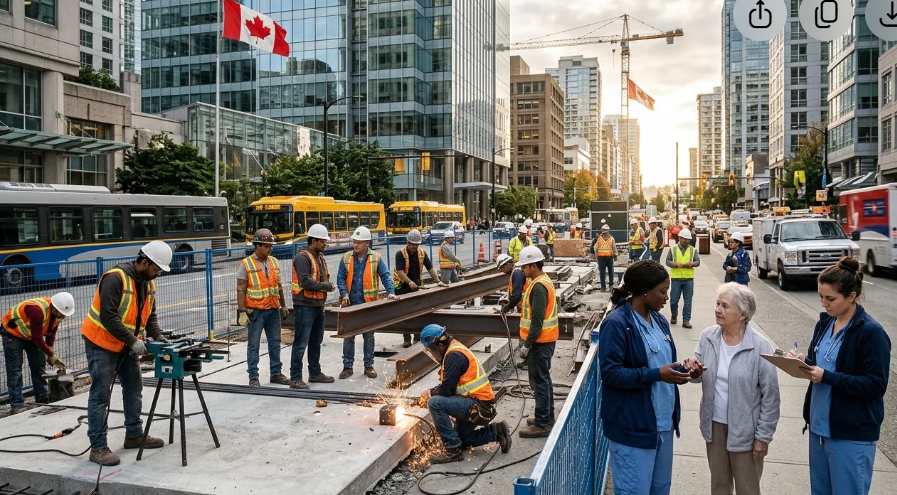
Canada is preparing to introduce significant changes to the Low-Wage Temporary Foreign Worker Program (TFWP), with a greater focus on occupations experiencing labour shortages. Starting March 1, 2027, participating provinces and territories will have a more targeted approach to hiring low-wage temporary foreign workers, potentially limiting access to occupations that are not identified as in demand.
The proposed changes are part of the federal government’s efforts to better align temporary foreign worker recruitment with regional labour market conditions, protect employment opportunities for Canadians, and address genuine labour shortages.
For foreign workers currently in Canada, prospective applicants, and employers relying on the TFWP, understanding these changes is important when planning future work permit applications, renewals, and recruitment strategies.
Here is what you need to know about the upcoming changes.
1. Canada Is Introducing an Occupation-Based Approach to Low-Wage LMIA Applications
On November 6, 2026, Employment and Social Development Canada (ESDC) announced targeted reforms to the Low-Wage Stream of the Temporary Foreign Worker Program.
The most significant proposed change is the introduction of an occupation-based system for certain regions.
Under the new approach, employers in participating provinces and territories will generally be able to obtain Labour Market Impact Assessments (LMIAs) under the Low-Wage Stream only for occupations identified as experiencing labour shortages or otherwise designated as eligible by the relevant province or territory.
The occupational eligibility list will be based on:
- Occupations identified through the Canadian Occupational Projection System (COPS).
- Additional occupations that provinces and territories choose to include based on their regional labour market needs.
- Occupations that provinces and territories decide to remove because they do not reflect local economic or workforce conditions.
This means that an occupation eligible for low-wage LMIA recruitment in one province may not necessarily qualify in another.
The federal government intends to work with provincial and territorial governments to ensure that foreign worker recruitment responds more directly to local labour shortages.
Important: The March 1, 2027 changes are conditional on provinces and territories opting in. They are not automatically being implemented nationwide on that date. Canada+1
2. Which Regions Will Be Affected by the New Restrictions?
The proposed occupation-based restrictions will depend on the size of the community and its unemployment rate.
The government has outlined different rules for large metropolitan areas, smaller metropolitan areas, and rural communities.
| Location | Proposed rules from March 1, 2027 |
|---|---|
| Large CMAs (population over 250,000), unemployment below 6% | Low-wage LMIAs will be processed only for eligible in-demand occupations. |
| Large CMAs, unemployment at 6% or higher | Existing restrictions will continue, subject to priority-sector exemptions. |
| Smaller CMAs (population 100,000–250,000) | Targeted access for eligible occupations. |
| Rural areas within large CMAs | Targeted access for eligible occupations. |
| Rural communities outside CMAs | Employers will retain access to all occupations under the Low-Wage Stream. |
A Census Metropolitan Area (CMA) is a statistical geographic area defined by Statistics Canada. It generally consists of a large urban centre and surrounding communities that have strong commuting connections to that centre.
One important distinction is that the new rules will not affect all communities in the same way.
For example, employers in a large metropolitan area with an unemployment rate below 6% may still be able to hire temporary foreign workers, but only for occupations on the applicable eligible list.
Meanwhile, employers in rural communities outside CMAs will retain access to all occupations under the Low-Wage Stream.Canada+1
3. What Counts as a Low-Wage Position?
The distinction between the Low-Wage and High-Wage Streams is based on the hourly wage offered to the foreign worker compared with the applicable provincial or territorial wage threshold.
A position is classified as low-wage if the offered hourly wage is below 120% of the median hourly wage in the province or territory where the job is located.
As of July 17, 2026, the applicable thresholds include:
| Province | Low-wage threshold |
|---|---|
| British Columbia | $38.40/hour |
| Alberta | $37.50/hour |
| Ontario | $36.92/hour |
| Manitoba | $31.33/hour |
| Saskatchewan | $34.62/hour |
| Nova Scotia | $31.96/hour |
| Quebec | $36.00/hour |
| New Brunswick | $31.73/hour |
For example, an employer in British Columbia offering $25 per hour for a position would generally fall under the Low-Wage Stream, while an offer of $40 per hour would generally fall under the High-Wage Stream, subject to the applicable program requirements.
The wage threshold is important because the new occupation-based restrictions discussed in this article apply specifically to the Low-Wage Stream, not automatically to all TFWP applications.
Employers should also remember that simply increasing the offered wage to qualify for the High-Wage Stream is not sufficient. The wage must be consistent with the prevailing wage for the occupation and comparable Canadian positions. Canada
4. Which Occupations Will Be Eligible?
One of the most important questions for employers and foreign workers is which occupations will be included on the new eligible list.
The federal government has indicated that the initial list will draw from the Canadian Occupational Projection System (COPS), which provides information about occupational labour market conditions and future workforce needs.
However, provinces and territories will have the flexibility to adjust the list by adding or removing occupations based on their own economic priorities.
This means that the final list may differ between provinces.
For example, a province experiencing shortages in construction, healthcare, food production, or other essential services may choose to prioritize occupations in those areas.
However, it would be premature to assume that every occupation within these industries will automatically qualify.
As of November 27, 2026, the detailed occupational eligibility lists and final provincial and territorial participation arrangements have not been confirmed in the federal announcement. Employers and workers should therefore wait for the official lists before making decisions based on a particular occupation. Canada+1
5. Existing Restrictions in High-Unemployment Areas Will Continue
The proposed occupation-based restrictions do not replace all existing TFWP restrictions.
Since September 26, 2024, the federal government has maintained a policy of refusing to process certain low-wage LMIA applications in Census Metropolitan Areas with an unemployment rate of 6% or higher.
This restriction is intended to prioritize available employment opportunities for Canadian citizens and permanent residents in areas where unemployment is relatively high.
Some priority sectors and occupations are exempt from this restriction.
These include:
- Primary agriculture.
- Construction.
- Food manufacturing.
- Hospitals.
- Nursing and residential care facilities.
- Certain in-home caregiver positions.
A new exemption effective November 6, 2026: Early childhood educators have also been added to the list of occupations exempt from the high-unemployment-area restriction.
This means employers may continue to submit eligible low-wage LMIA applications for early childhood educators even when the job is located in a CMA with an unemployment rate of 6% or higher, subject to other program requirements.
For employers in large metropolitan areas, this distinction is particularly important because the existing unemployment-based restriction will continue to apply even after the new occupation-based system begins.Canada+1
6. Low-Wage LMIA Duration Has Increased from One Year to Two Years
Alongside the proposed occupational restrictions, the federal government has introduced a change that may benefit employers and foreign workers.
Effective November 6, 2026, low-wage LMIA applications submitted on or after that date can have a maximum employment duration of up to two years, compared with the previous maximum of one year.
This change is intended to provide employers with greater workforce stability and reduce the need to repeat the LMIA recruitment process as frequently.
For temporary foreign workers, a longer LMIA duration may provide an opportunity to obtain a work permit with a longer validity period.
However, there are several important points to understand:
- The two-year maximum applies to the LMIA employment duration, not an automatic two-year work permit for every applicant.
- IRCC makes the final decision on work permit applications.
- The actual work permit validity period may depend on the LMIA, passport validity, and other applicable requirements.
- Workers who want to extend their work permits must continue to meet the relevant immigration requirements.
This change is already in effect and is separate from the proposed March 1, 2027 occupation-based restrictions. Canada+1
7. Employers May Be Allowed to Hire More Low-Wage Temporary Foreign Workers
Another proposed change concerns the maximum proportion of low-wage temporary foreign workers an employer can hire.
Currently, employers are generally subject to a 10% cap on the proportion of their workforce that can consist of low-wage temporary foreign workers.
Certain priority sectors, including construction, food manufacturing, hospitals, and nursing and residential care facilities, are subject to a higher 20% cap.
Under the proposed reforms, provinces and territories may opt in to additional flexibility for eligible employers in communities they identify.
If a province or territory requests this flexibility, eligible employers could be allowed to increase the low-wage temporary foreign worker proportion from 10% to 15% of their workforce.
The existing 20% limit for priority sectors would remain unchanged.
Importantly, the proposed 15% flexibility is not automatic. It depends on provincial or territorial participation and the eligibility of the employer and community.Canada+1
8. What Do These Changes Mean for Foreign Workers Already in Canada?
Foreign workers currently working in Canada under the Low-Wage Stream may be concerned about how the upcoming changes could affect their employment and work permit status.
The important distinction is that the March 1, 2027 reforms primarily concern the processing of new LMIA applications under the Low-Wage Stream.
The announcement does not state that existing work permits will automatically be cancelled because an occupation is not included on a future eligible list.
However, workers planning to extend their work permits should pay close attention to the new rules.
For example:
- If an employer needs a new low-wage LMIA to support a work permit extension, the occupation and work location may need to satisfy the new eligibility rules.
- If the occupation is not included on the applicable provincial or territorial list, obtaining a new LMIA may become more difficult or unavailable under the affected rules.
- If the employer is located in a rural community outside a CMA, the proposed system will retain access to all occupations under the Low-Wage Stream.
- Workers in exempt priority sectors may continue to benefit from specific exemptions, subject to applicable requirements.
Foreign workers should not assume that their current work permit will be extended automatically or that their employment will necessarily be affected immediately when the new rules take effect.
They should review their work permit expiry dates and discuss future LMIA plans with their employers well in advance.
9. Does This Affect the High-Wage TFWP or International Mobility Program?
No. The proposed occupation-based restrictions are specifically directed at the Low-Wage Stream of the Temporary Foreign Worker Program.
The High-Wage Stream is not subject to this particular new occupation-based restriction, although employers must continue to satisfy all applicable LMIA requirements and other restrictions.
Similarly, the International Mobility Program (IMP) operates separately from the TFWP.
Many work permits issued under the IMP do not require an LMIA because they are supported by specific exemptions under Canadian immigration law, international agreements, or other public policies.
Examples include certain:
- International trade agreement work permits.
- Intra-company transferee work permits.
- International Experience Canada work permits.
- Francophone Mobility work permits.
Therefore, foreign workers may still have other work permit options depending on their qualifications, employment arrangements, nationality, and eligibility.
However, being ineligible for a low-wage LMIA does not automatically make someone eligible for an LMIA-exempt work permit.
Applicants must independently meet the requirements of the alternative immigration category. Canada+1
10. What Should Employers and Foreign Workers Do Before March 1, 2027?
With the proposed changes approaching, both employers and foreign workers should review their immigration and employment plans.
For employers:
- Review whether their positions fall under the Low-Wage or High-Wage Stream.
- Check the unemployment rate and geographic classification of the work location.
- Monitor announcements from their provincial or territorial government regarding participation in the new system.
- Review whether their occupations are likely to qualify under the future eligible list.
- Consider submitting necessary LMIA applications early, provided they meet the current requirements.
- Explore alternative recruitment strategies if their occupations may no longer qualify.
For foreign workers:
- Check the expiry date of their current work permits.
- Discuss LMIA renewal plans with their employers well before their permits expire.
- Determine whether their occupations may be affected by the new restrictions.
- Explore other available work permit options, including eligible LMIA-exempt categories.
- Consider whether they may qualify for permanent residence through the Provincial Nominee Program (PNP), Express Entry, or other economic immigration pathways.
Foreign workers should not wait until their work permits are close to expiring before exploring their options.
Conclusion: Canada’s TFWP Is Becoming More Targeted
Canada’s proposed changes represent another step toward making the Temporary Foreign Worker Program more responsive to regional labour market needs.
By introducing occupation-based restrictions in certain metropolitan and rural areas, the federal government intends to direct low-wage foreign worker recruitment toward occupations where labour shortages are more evident.
For employers, this means that access to foreign workers may increasingly depend on the occupation, location, and provincial or territorial labour market priorities.
For foreign workers, particularly those employed in low-wage positions, it will become increasingly important to understand whether their occupations remain eligible for LMIA-supported employment and whether alternative work permit or permanent residence pathways are available.
The key date to remember is March 1, 2027. However, the new occupation-based system is conditional on provincial and territorial participation, and the detailed occupational lists have yet to be confirmed.
Employers and foreign workers should follow official government announcements closely and prepare for the transition rather than assuming that the current rules will remain unchanged.
Official Government Resources
For the latest information, employers and foreign workers should consult the following Government of Canada resources:
1. Government Announces Targeted Reforms to the Temporary Foreign Worker Program (November 6, 2026)
https://www.canada.ca/en/employment-social-development/news/2026/11/government-of-canada-announces-targeted-reforms-to-the-temporary-foreign-worker-program-to-respond-to-labour-market-needs.html
2. Temporary Foreign Worker Program – Temporary Measures
https://www.canada.ca/en/employment-social-development/services/foreign-workers/temporary-measures.html
3. Refusal to Process a Labour Market Impact Assessment Application
https://www.canada.ca/en/employment-social-development/services/foreign-workers/refusal.html
4. Low-Wage and High-Wage LMIA Thresholds by Province or Territory
https://www.canada.ca/en/employment-social-development/services/foreign-workers/median-wage.html
5. Canadian Occupational Projection System (COPS)
https://occupations.esdc.gc.ca/sppc-cops/
6. International Mobility Program (IMP)
https://www.canada.ca/en/immigration-refugees-citizenship/services/work-canada/permit/temporary/work-permit-exemptions.html
Article updated November 27, 2026. This article is based on the federal government’s November 6, 2026 announcement and official program information available on the publication date. The March 1, 2027 occupation-based measures remain conditional on provincial and territorial opt-in. The final eligible occupation lists and participation details may change.