
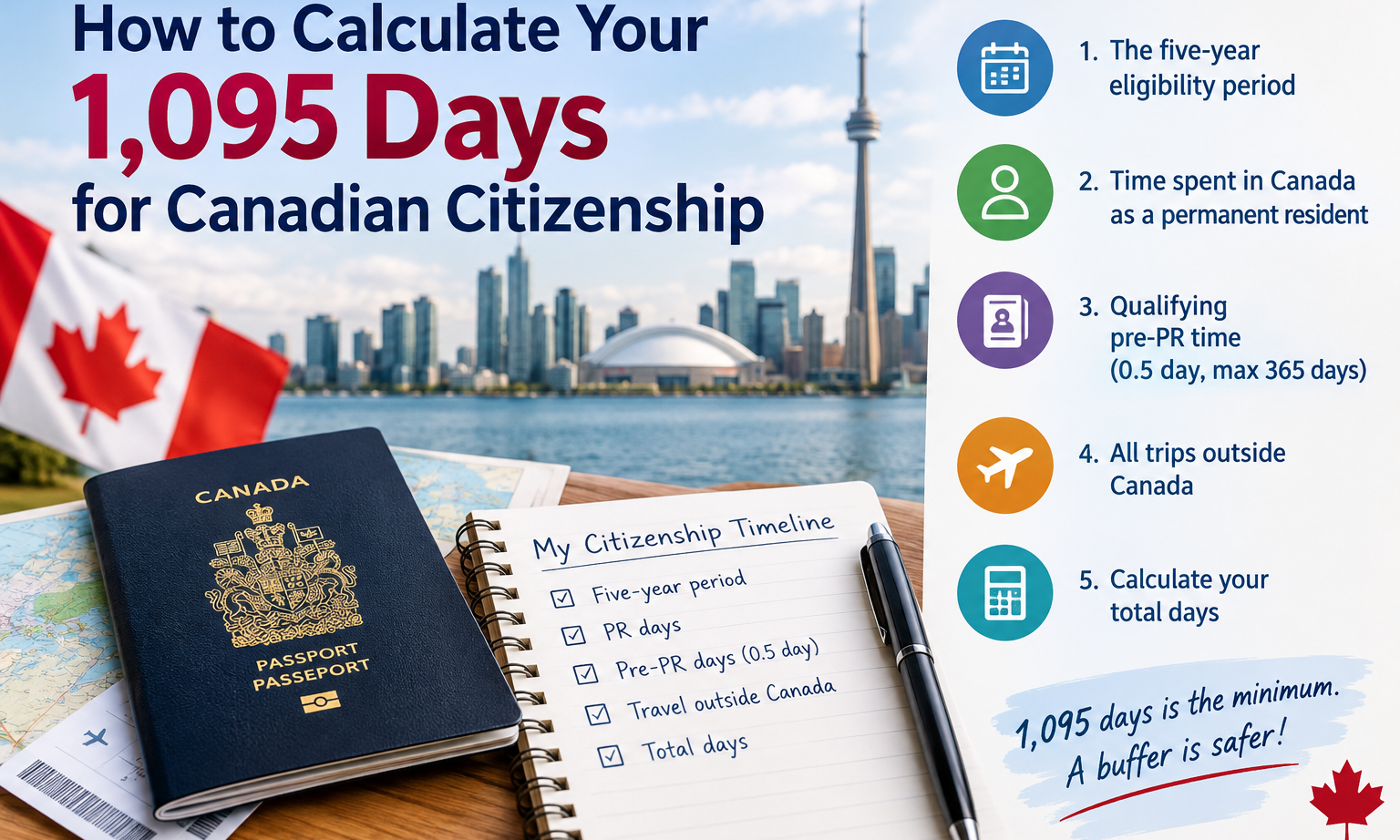
For many permanent residents, one of the biggest questions before applying for Canadian citizenship is simple:
When have I accumulated enough days in Canada to apply?
The basic rule is that an adult applicant must have been physically present in Canada for at least 1,095 days during the five-year period immediately before the date the citizenship application is signed.
But calculating 1,095 days is not simply a matter of counting the days since becoming a permanent resident. Certain time spent in Canada before becoming a permanent resident may also count, travel outside Canada must be accounted for carefully, and the exact application date can change the five-year eligibility period.
Here is how the calculation works.
What does the 1,095-day requirement mean?
To qualify for Canadian citizenship as an adult, a permanent resident generally must have been physically present in Canada for at least 1,095 days — equivalent to three years — during the five years immediately before applying.
The five-year period is called the eligibility period.
For example, if an applicant signs the citizenship application on September 18, 2026, IRCC looks at the five years immediately before that date.
The calculation is therefore based on the applicant’s actual physical presence in Canada during that specific five-year period.
Importantly, there is no requirement to spend a minimum number of days in Canada in each individual year. The requirement is a total of 1,095 days within the five-year eligibility period.
Step 1: Determine the five-year eligibility period
The first step is to identify the five-year period immediately before the date the application is signed.
This matters because days outside that five-year window generally cannot be counted toward the 1,095-day requirement.
For example, if an application is signed on September 18, 2026, the relevant period is the five years immediately preceding that date.
Applicants should therefore avoid calculating their citizenship eligibility simply from the date they became permanent residents.
The relevant question is:
How many qualifying days were spent physically in Canada during the five-year eligibility period?
Step 2: Count every day physically present in Canada as a permanent resident
For most permanent residents, each day physically present in Canada after becoming a permanent resident counts as one full day toward the citizenship requirement.
For example:
- 1 day in Canada as a PR = 1 day
- 100 days in Canada as a PR = 100 days
- 1,000 days in Canada as a PR = 1,000 days
This is different from certain time spent in Canada before becoming a permanent resident.
Step 3: Pre-PR temporary-resident time may count as half-days
One of the most important rules is that some time spent in Canada before becoming a permanent resident can count toward citizenship.
If a person was physically present in Canada as an authorized temporary resident or protected person during the five-year eligibility period, each qualifying day generally counts as 0.5 day toward the citizenship requirement.
However, there is a maximum credit of 365 days for this pre-PR time.
Temporary resident status can include lawful authorization as:
- a visitor
- a student
- a worker
- a temporary resident permit holder.
For example, if someone spent 400 days in Canada as a qualifying temporary resident before becoming a PR:
400 × 0.5 = 200 citizenship days
If someone spent 730 qualifying days in Canada before becoming a PR:
730 × 0.5 = 365 citizenship days
The maximum of 365 days has therefore been reached.
An applicant cannot receive more than 365 days of citizenship credit for pre-PR temporary-resident or protected-person time.
A simple example
Consider someone who spent:
- 730 days in Canada as a temporary resident before becoming a PR
- 800 days in Canada as a permanent resident
The calculation would be:
730 temporary-resident days × 0.5 = 365 days
800 PR days × 1 = 800 days
Total = 1,165 days
In this example, the applicant would have more than the required 1,095 days, assuming all of the time falls within the five-year eligibility period and all other citizenship requirements are satisfied.
Step 4: Subtract time spent outside Canada
This is where many citizenship calculations become complicated.
Applicants need to account for every absence from Canada during the eligibility period.
The IRCC physical presence calculation asks applicants to provide their travel history and uses the information to determine the number of days physically present in Canada.
A travel journal can be used to keep track of trips outside Canada, although IRCC says the travel journal itself does not need to be submitted with the application.
Applicants should therefore review:
- passports and entry/exit stamps;
- flight records;
- travel bookings;
- work travel records;
- hotel records;
- border records; and
- other documentation that can help reconstruct travel dates.
The objective is not simply to estimate the number of days abroad. The application should contain an accurate travel history.
Does the day of departure count?
For citizenship physical presence calculations, the key issue is the applicant’s physical presence on each day.
Applicants should therefore use IRCC’s physical presence calculator rather than attempting to create their own rules for counting departure and return dates.
This is particularly important for short trips, where a difference of one or two days can affect the final calculation.
IRCC recommends using its online Physical Presence Calculator because it is designed specifically for citizenship applications.
What happens if someone has exactly 1,095 days?
Technically, 1,095 days meets the minimum physical presence requirement, assuming the calculation is correct and all other eligibility requirements are satisfied.
However, IRCC recommends applying with more than 1,095 days to provide a margin for calculation errors or other issues that could reduce the final physical-presence total.
This is an important practical point.
If an applicant’s calculation shows exactly 1,095 days, even a small error in a travel date could potentially reduce the total below the minimum.
Waiting until there is a reasonable buffer can reduce this risk.
What if there are several trips outside Canada?
Applicants should not simply add up the number of trips.
The relevant figure is the total time physically outside Canada during the five-year eligibility period.
For example, someone could have:
- Trip 1: 10 days
- Trip 2: 25 days
- Trip 3: 7 days
- Trip 4: 40 days
The applicant has to account for the applicable days outside Canada and ensure that the physical-presence calculation accurately reflects the travel history.
Multiple short trips can be particularly easy to overlook when reconstructing several years of travel.
What if the applicant was a student or worker before becoming a PR?
This is one of the most useful aspects of the current citizenship rules.
Qualifying time spent in Canada before permanent residence can count.
For example, a person might have entered Canada as an international student, later obtained a work permit and eventually became a permanent resident.
If the relevant time falls within the five-year eligibility period and the person had qualifying temporary resident status, those days may receive the 0.5-day credit, subject to the 365-day maximum.
This can significantly reduce the number of full days that the person needs to accumulate after becoming a permanent resident.
However, applicants should not assume that every period physically spent in Canada before PR automatically qualifies.
The person’s immigration status during the relevant period matters.
What about protected persons?
Time physically spent in Canada as a qualifying protected person before becoming a permanent resident may also count at 0.5 day per day, subject to the 365-day maximum.
IRCC specifies that, for protected persons, the relevant period generally runs from the date the person received a positive decision on the refugee claim or PRRA application until the day before becoming a permanent resident.
What about time spent outside Canada with a Canadian spouse?
There are very limited circumstances in which certain time outside Canada can count toward the physical presence requirement.
These exceptions can apply in specific circumstances involving a Crown servant and certain family members, and there are other narrowly defined situations.
They should not be treated as a general rule that living abroad with a Canadian spouse automatically counts as physical presence in Canada.
Applicants with unusual residence circumstances should examine the specific IRCC rules rather than assuming that time abroad qualifies.
Don’t confuse citizenship residency with the PR residency obligation
Another common mistake is confusing the two requirements.
A permanent resident generally needs at least 730 days of physical presence in Canada during the relevant five-year period to meet the PR residency obligation.
Citizenship generally requires 1,095 days during the five-year eligibility period.
These are different requirements.
A person can meet the PR residency obligation without yet having enough physical presence to apply for citizenship.
What about Canadian tax filing?
Physical presence is not the only citizenship requirement.
Applicants may also need to have met their personal income tax filing obligations for at least three taxation years that are fully or partially within the five-year period immediately before applying.
This does not mean that every applicant must automatically file a Canadian tax return for every year.
The requirement is tied to whether the applicant was required to file under the Income Tax Act.
Applicants should therefore review their tax obligations separately from their physical-presence calculation.
Use IRCC’s Physical Presence Calculator
Applicants should not rely solely on a spreadsheet or handwritten calculation.
IRCC currently recommends using the online Physical Presence Calculator. For online citizenship applications, the calculator is available through the applicant’s online account and must be completed there.
For paper applications, applicants can use the online calculator and include the printed calculation with the application, or use form CIT 0407 if they cannot or do not want to use the online calculator.
IRCC also provides a travel journal that applicants can use to organize their trips. The travel journal is optional and does not need to be submitted.
A practical way to prepare your calculation
Before starting the application, it can be useful to build a complete timeline covering the five-year eligibility period.
1. Identify the application date
The five-year eligibility period is calculated backwards from the date the application is signed.
2. Identify the PR landing date
Separate time spent in Canada before and after becoming a permanent resident.
3. List all pre-PR qualifying periods
Identify periods when you were physically present in Canada as an eligible temporary resident or protected person.
4. Record every trip outside Canada
Use passports, travel records and other documentation to reconstruct the travel history.
5. Enter the information into IRCC’s calculator
Let the official calculator apply the applicable rules rather than relying entirely on a manual calculation.
6. Check for a buffer
If the calculation is only slightly above 1,095 days, consider waiting until there is a larger margin before applying.
Common mistakes to avoid
Mistake 1: Counting only time after becoming a PR
Some applicants forget that qualifying temporary-resident and protected-person time may count at half-day credit.
Mistake 2: Treating every pre-PR day as a full day
Pre-PR qualifying time generally counts as 0.5 day, not one full day, and is subject to the 365-day maximum.
Mistake 3: Ignoring short trips
Several short trips can add up to a significant number of days outside Canada.
Mistake 4: Using the wrong five-year period
The calculation is based on the five years immediately before the application date.
Mistake 5: Applying with exactly 1,095 days without checking the travel history
IRCC recommends applying with more than the minimum to reduce the risk of falling below the threshold because of an error.
Mistake 6: Assuming citizenship and PR residency requirements are identical
They are not. The citizenship physical-presence requirement is 1,095 days, while the general PR residency obligation is 730 days in five years.
Bottom Line
The 1,095-day citizenship requirement is based on physical presence in Canada during the five-year period immediately before the application.
The calculation can include:
- 1 full day for each qualifying day physically present in Canada as a permanent resident;
- 0.5 day for each qualifying day physically present in Canada as a temporary resident or protected person before becoming a PR, up to a maximum credit of 365 days;
- applicable limited exceptions for certain time spent outside Canada.
Because travel history and pre-PR status can materially affect the calculation, applicants should use IRCC’s official Physical Presence Calculator rather than relying solely on a manual calculation.
Most importantly, 1,095 is the minimum, not a target that must be hit exactly. IRCC recommends having more than 1,095 days before applying to provide some protection against calculation errors.
Official IRCC tool: Applicants can use the current Physical Presence Calculator to determine whether they meet the citizenship requirement.

