
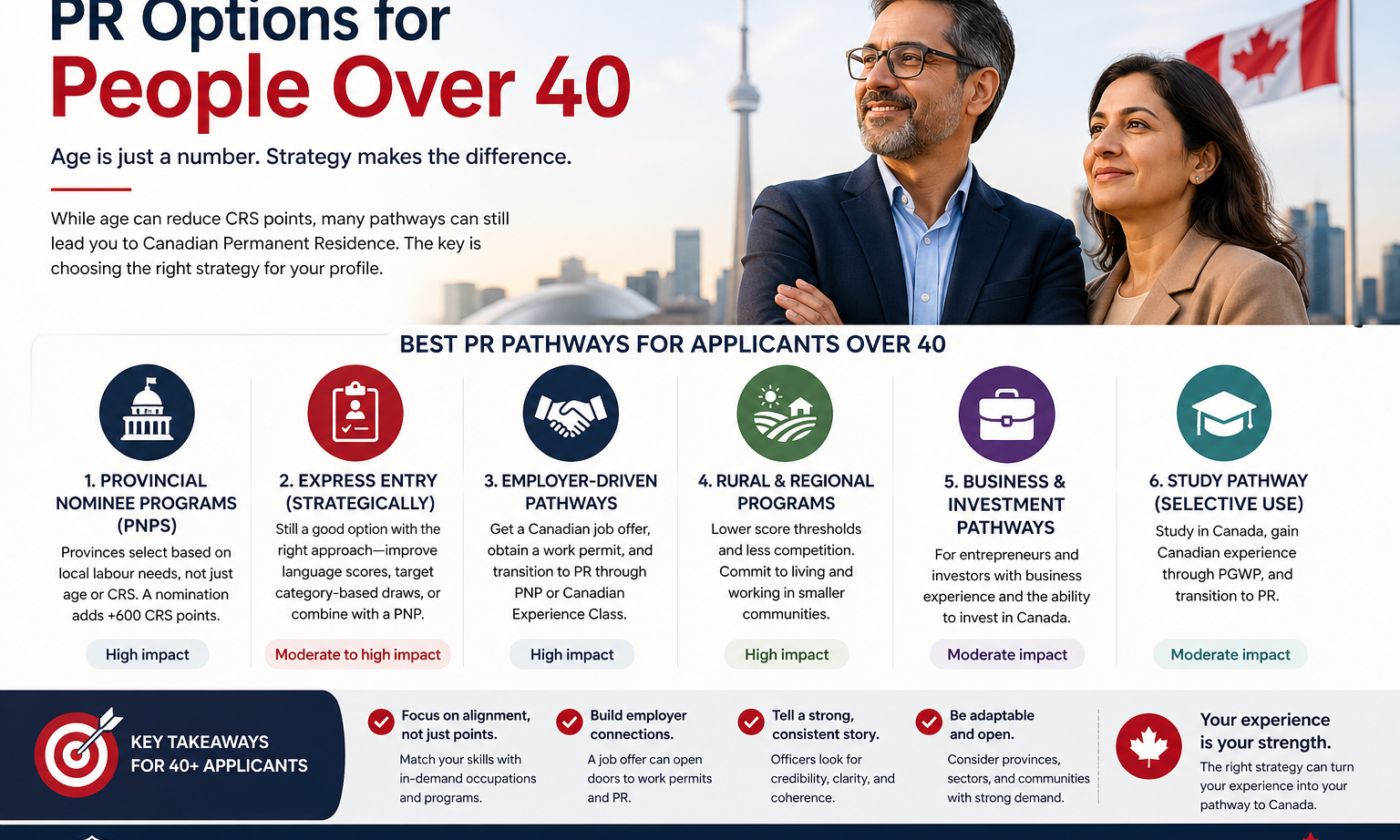
1) Provincial Nominee Programs (PNPs) — Highest Leverage
PNPs select candidates based on local labour needs, not just age or CRS.
Why it works:
- Provinces can nominate candidates outside federal ranking pressure
- A nomination adds +600 CRS points, effectively guaranteeing an invitation
Strong PNP pathways in 2026:
- Alberta Advantage Immigration Program (AAIP) — sector-targeted draws (healthcare, trades, rural)
- Ontario Immigrant Nominee Program (OINP) — human capital and employer streams
- British Columbia PNP — tech and healthcare focus
Best fit:
- Candidates with in-demand occupations
- Those with provincial ties or job offers
2) Express Entry (With Strategic Positioning)
Express Entry is still viable—but not as a standalone strategy.
How to make it work over 40:
- Combine with a PNP nomination
- Target category-based draws (e.g., healthcare, French language)
- Maximize language scores (IELTS/CELPIP)
Key reality:
Without enhancement, CRS alone may not be sufficient.
3) Employer-Driven Pathways (Work Permit → PR)
This is one of the most reliable routes.
Pathway structure:
- Secure a Canadian job offer
- Obtain a work permit (LMIA or LMIA-exempt)
- Transition to PR via PNP or Canadian Experience Class
Why it works:
- Real Canadian work experience offsets age disadvantages
- Employer support signals low immigration risk
Best fit:
- Skilled professionals
- Tradespeople
- Candidates open to relocation flexibility
4) Rural and Regional Immigration Programs
Programs targeting smaller communities often have:
- Lower score thresholds
- Higher selection probability
Examples:
- Rural Renewal Stream (Alberta)
- Rural community pilots
Trade-off:
- Must commit to living outside major cities
Advantage:
- Less competition from younger, high-CRS candidates
5) Business and Investment Pathways
For experienced professionals and entrepreneurs:
Options include:
- Provincial entrepreneur streams
- Start-up Visa program
Requirements:
- Business experience
- Investment capacity
- Viable business plan
Best fit:
- Executives, business owners, senior professionals
6) Study Pathway (Selective Use)
Studying in Canada can still work—but must be strategically justified.
When it works:
- Clear career progression
- Program aligns with prior experience
- Leads to a Post-Graduation Work Permit (PGWP)
Risk:
- Applications can be refused if the study plan appears weak or inconsistent
What Successful 40+ Applicants Do Differently
1) They prioritize alignment over points
- Occupation + provincial demand > raw CRS score
2) They build employer connections
- Job offers significantly improve outcomes
3) They present strong, coherent narratives
- Officers assess credibility, not just qualifications
4) They reduce risk signals
- Address gaps, explain transitions, ensure consistency
Common Mistakes to Avoid
- Relying only on CRS improvement
- Applying broadly without a clear strategy
- Ignoring provincial opportunities
- Submitting inconsistent employment or financial information
- Choosing study programs that do not align with career history

